Fatal Passage Turns 25 Years Old
An Open Letter to Explorer John Rae
Dear Doctor Rae:
Would you believe that Fatal Passage is now twenty-five years old?
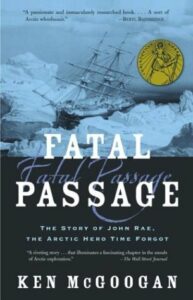
I write from the future to remind you that the book appeared in 2001, bringing your extraordinary life and times into the 21st century. You may recall that I met your ghost in 1998, during a three-month fellowship at the University of Cambridge. That’s a story for another day.
But while working on what would become Fatal Passage, I realized how shamefully you had been mistreated. I followed you north to Orkney, visited your boyhood home, the Hall of Clestrain, and came away determined to set the record straight. And so made my way to the Arctic.
I was mighty impressed with how, in the 1830s and ‘40s, while working as a doctor for the Hudson’s Bay Company, you learned from Indigenous experts and became an outstanding overland traveler. You charted 1,800 miles of Arctic coastline and discovered Rae Strait, the final link in the first navigable Northwest Passage.
Then, assisted by translator William Ouligbuck Jr., you determined the fate of the long-lost Franklin expedition. In 1845, Sir John Franklin had sailed from England and disappeared into the Arctic with two ships and 128 men. Nine years later, within view of King William Island, you gleaned from Inuit hunters that the expedition had ended in disaster. Starving crewmen abandoned the two vessels and some, retreating southward, resorted to cannibalism.
Remember the backlash to this revelation? Charles Dickens led the attack on you and your Inuit informants. Lady Franklin pulled strings and built statues to ensure that the world feted not yourself but the good Sir John as the great Arctic hero. And after you died in 1893, the keepers of official history sought to erase you.
That was the story I told in Fatal Passage, published by HarperCollins Canada. Over the years, the book would sport several different subtitles, most memorably The Story of John Rae, the Arctic Hero Time Forgot.
What happened next is all down to you. To my amazement, the book spent fourteen weeks on Canadian bestseller lists. Then it began winning awards: the Drainie-Taylor Biography Prize, the Lela Common History Award, the Grant MacEwan Author’s Prize, and an American Christopher Award for “a work of artistic excellence that affirms the highest values of the human spirit.”
Fatal Passage has sold 60,000 copies, mostly in Canada and the United Kingdom. And in 2008, it spawned a feature-length movie by celebrated film-maker John Walker. The docudrama Passage framed your story from contemporary London, featured cameos by the Orcadian historian Tom Muir, the Inuk Tagak Curley, and a shameless Canadian — moi.
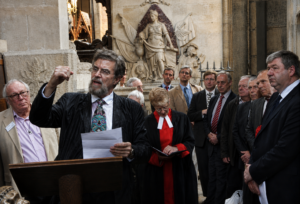 But since then, something more important has happened. Dr. Rae, you have emerged from the shadows. In September 2013, I was serving as writer-in-residence in Orkney when several hundred people gathered in Stromness harbour to unveil a bronze statue of you overlooking the sea. Alistair Carmichael, the local MP, announced that he had persuaded the Dean of Westminster to recognize you in the Abbey. The plan called for a mounted plaque that would hail you as discoverer of the final link in the first navigable Northwest Passage.
One year later, thanks to determined campaign by pro-Franklin naysayers, the plaque had become something less grand — a ledger stone to be placed at the foot of the elaborate Franklin memorial. Even so, on September 30, 2014, your 201st birthday, I joined a standing-room-only gathering in the Chapel of St. John the Evangelist for the dedication. The stone reads simply: “John Rae / 1813–1893 / Arctic Explorer.”
I was given five minutes to offer a public reflection and spoke of how you had finished the work that John Franklin began. The navy man’s ships had sailed south down Peel Sound and become trapped northwest of King William Island. Eight years later, travelling overland Inuit-style, you discovered both the expedition’s fate and the waterway that would enable Roald Amundsen to complete the first navigation of the Northwest Passage.
In 2016, on your 203rd birthday, I wrote you my first open letter. “Slowly,” I reported, “we are winning the war to vindicate you and your Inuit informants.” I wrote to you again in 2022. By then, underwater archaeologists were exploring the wrecks of the two Franklin ships, and the John Rae Society was well embarked on restoring the Hall of Clestrain as a centre devoted Arctic exploration. “We keep our shoulders to the wheel,” I told you. “John Rae lives!”
So what can I report today? Twenty-five years after Fatal Passage appeared, John Franklin remains the most celebrated of all Arctic explorers. Outrageous, of course. But the old story is slowly changing. Historians now recognize your role in determining “the fate of Franklin.” Your trust in Inuit testimony has been repeatedly vindicated. Your ledger stone is installed in Westminster Abbey. And in Orkney, the John Rae Society is slowly reviving the house where your journey began.
Twenty-five years ago, Doctor Rae, I called you “the Arctic hero time forgot.”
Today, I withdraw that subtitle. You, sir, are not forgotten. Once more with feeling: John Rae lives!

Excellent.
Two wonderful stories of achievement.