Canada Day arrives early at The Toronto Star
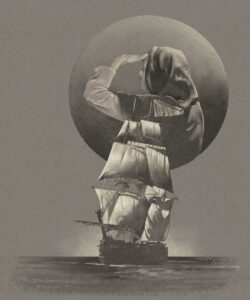
Illustration for The Star by Eric Colquhoun
The most Canadian journey ever undertaken?
While the United States threatens once again to subsume us, Canadians have embraced a new nationalism. But beyond the cliches about politeness and maple syrup, what is this Canadianness we seek to preserve? We asked six of our compatriots to pick a story from our country’s past — a great Canadian narrative — that captures something essential about this country. Here’s what Ken McGoogan had to say. As published in The Toronto Star.
One morning in the spring of 1784, when she was fifty years old and in poor health, Isabella Fraser led eight of her nine children out the door of her farmhouse in upstate New York, where the family had lived for almost a decade. The youngest, Simon, was eight years old. The oldest had already left home.
She didn’t intend it, but in setting out to lead her family 350 km north to Montreal, this indomitable widow had launched into what might be considered the most Canadian journey ever undertaken – one that evolved out of the Highland Clearances, resisted the American Revolution, embraced United Empire Loyalism, engaged coureurs de bois and First Nations allies, and culminated in a pioneer expedition to the Pacific Ocean.
The family travelled first by horse-drawn wagon overland, rattling along rough roads toward Fort Edward. This initial stretch recalled a much earlier journey. In 1773, Isabella and her husband, Simon Fraser Sr., had left the Scottish Highlands during the Clearances, sailing from Fort William aboard the Pearl.
Both Isabella (nee Grant) and her husband, Simon Fraser Sr., had received a classical education. Their parents had supported the Jacobite uprisings and resisted the dismantling of the clan system. With repression intensifying and opportunity shrinking, they departed with 425 Roman Catholic clansmen. They brought with them a library of rare Gaelic books and manuscripts.
The Frasers found temporary refuge in Albany before purchasing a 160-acre farm in nearby Hoosick, New York. Isabella raised children, handled livestock, churned butter, and spun wool while Simon managed the farm. In 1775, with the eruption of the American Revolution, everything changed. The Frasers—Loyalists by conviction and culture—were increasingly targeted by rebel neighbours.
In 1777, Isabella’s husband and eldest son joined the British forces – an allegiance that cost them dearly. Simon Sr. was captured at the Battle of Bennington, imprisoned in Albany, and died in jail two years later after reported beatings and starvation. Rebels looted their farm, seized their livestock, and destroyed their precious books and manuscripts. Isabella was left a widow with young children and no legal claim to most of her land.
She held on while the persecution intensified. In 1784, encouraged by her Montreal-based brother-in-law, Isabella gathered her eight children and began the long journey north. From Fort William Henry, the family sailed up Lake George and Lake Champlain, then via the Richelieu River to the British military post of St. John’s – now Saint-Jean-sur-Richelieu. From there, her eldest son, still in uniform, met them and led them west to a Loyalist settlement at Coteau-du-Lac, just west of Montreal.
Isabella petitioned the British government for reparations, citing her widowhood, illness, and wartime losses. Ultimately, she settled in Saint Andrews near the Glengarry settlement of displaced Highlanders.
Her youngest son, Simon Fraser, picked up her story. At fourteen he moved to Montreal, a frontier city of 8,500. He lived with his uncle, Judge John Fraser, while attending a rough-country version of high school. At sixteen he joined the fur-trading North West Company, which sent voyageurs deep into the north country to trade with First Nations, so saving them a long, hard canoe trip to Hudson’s Bay Company trading posts.
Simon spent a dozen years at Forty Chipewyan in the Athabasca Department, a main fur-trade depot for the Mackenzie River region. Then, in the spring of 1808, he led twenty-three men in charting a hazardous river roaring south from Fort George through steep-walled canyons. Thirty-six days, 840 kilometres: to his surprise, this harrowing run down what is now the Fraser River culminated at the Pacific Ocean.
The Fraser family journey reminds us that Canada has a history of people displaced by war, loyalty, and revolution. Isabella’s life bridged continents and causes, and her legacy lives on in the river named after her son. This Canada Day, as we reflect on who we are and how we got here, we celebrate the fierce determination of a family bent on building a better world.

Wonderful story. The Fraser River should be attributed to the entire family, including Isabel, who is a hero. Just btw, the river’s name in the Halqemeylem (Upriver Halkomelem) language is Sto:lo. The river’s name in the Dakelh language is Lhtakoh. The Tsilhqot’in name for the river is ʔElhdaqox, meaning Sturgeon (ʔElhda-chugh) River (Yeqox). (Got that from wikipedia.)
Terrific.