Arctic Focus chases me through History
As I interviewed Ken in his home over a decade later, I was surrounded by the vivid, sweeping Arctic paintings of his late wife, Sheena. Her artwork, from the rugged coastlines of Orkney to John Rae’s ancestral home, reflects the landscapes they had explored together, serving as quiet, poignant reminders of their shared passion for the North.
Inspiration, Mysteries, and Expanding the Arctic Lens
McGoogan’s journey into Arctic history began with a book: Company of Adventurers by Peter C. Newman. Among its many characters, one name captured his imagination –John Rae, the Scottish explorer whose discovery of the final navigable link in the Northwest Passage had been largely erased from the historical record in favour of the more mythologized Franklin.
Shortly afterward, McGoogan won a fellowship to the University of Cambridge, where he intended to write a novel modelled on A.S. Byatt’s Possession. But once he began researching Rae’s life at the Scott Polar Research Institute and saw firsthand how overlooked he was, McGoogan realized that fiction would not suffice.
“I thought, this guy’s been ripped off by history. I have to set the record straight.” The result was Fatal Passage, a non-fiction account that became his breakout work. The book won multiple awards and was turned into a feature-length docudrama, launching McGoogan as a definitive voice in Arctic literature.
 McGoogan’s following projects continued his deep dive into Arctic history, with particular focus on the nuanced relationships between European explorers and Indigenous communities. Rae’s deep respect for Inuit knowledge stood in stark contrast to many of his contemporaries, a quality that McGoogan found not only admirable but essential.
That exploration led to another intriguing figure: Samuel Hearne, the 18th-century explorer who became the first European to reach the Arctic Ocean overland, thanks mainly to the leadership of Dene guide Matonabbee. In researching Hearne, McGoogan again travelled to key locations, from Dorset and Portsmouth to Canada’s far North, cementing his method of walking in his subject’s footsteps.
Another unlikely subject, Jane Lady Franklin, caught McGoogan’s attention. While writing Fatal Passage, he viewed her critically, particularly for undermining Rae after he brought back reports of cannibalism among her husband’s doomed crew. But the deeper he investigated her life, the more complex and fascinating she became. From her quiet influence on her husband’s colonial administration in Tasmania to her travels in the Middle East and relentless campaign to preserve Franklin’s legacy, Lady Franklin emerged as a Victorian-era force. In Lady Franklin’s Revenge, McGoogan re-framed her as one of the era’s great adventurers and political operatives, which earned him the prestigious Pierre Berton Award.
The Indigenous role in Arctic exploration remained central to McGoogan’s research. Initially, he pitched a book focused solely on Inuit perspectives, but publishers hesitated. Undeterred, he broadened the scope and released Dead Reckoning, which emphasized Indigenous contributions while exploring the broader history of Arctic discovery. For McGoogan, the aim was clear: to center the people who had made exploration possible in the first place.
One of McGoogan’s most compelling contributions to Arctic scholarship is his theory on the fate of Franklin’s final expedition. While conventional theories posited lead poisoning, botulism, or scurvy, McGoogan proposed a different culprit: trichinosis, a parasitic disease contracted in this case from undercooked polar bear meat.
In Searching for Franklin, he wove together historical evidence, Inuit oral testimony, and modern science to support this theory. He consulted epidemiologists and looks forward to scientific proof from polar bear meat stored in barrels aboard Franklin’s two ships, the Erebus and the Terror. The theory is gaining a following among many historians and scientists.
“It took me six books and twenty-five years,” McGoogan says. “But the pieces finally fit.” In making the case, he not only solved a riddle that had haunted Arctic history, he revealed how deep fieldwork, local knowledge, and scientific rigour can converge.
Perhaps the most satisfying outcome of McGoogan’s work to date has been the growing recognition of John Rae. On his first visit to Rae’s birthplace in Orkney, Scotland, McGoogan was struck by the reverence the locals held for Rae and their frustration that his legacy remained obscure outside the region. Thanks to McGoogan’s efforts, that has begun to change. His books have been published internationally, and the docudrama based on Fatal Passage brought Rae’s story to screens. The John Rae Society continues its work to transform Rae’s ancestral home into an Arctic museum, a project on which McGoogan has served as a patron from the beginning.
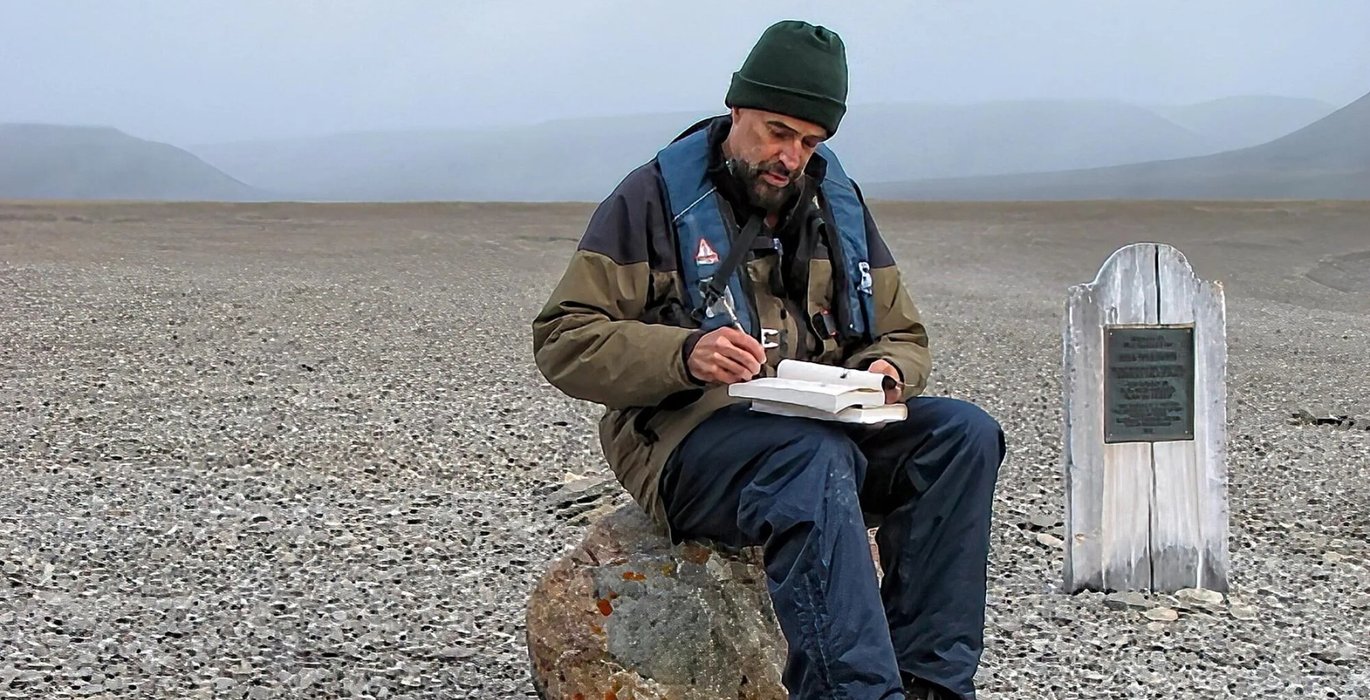
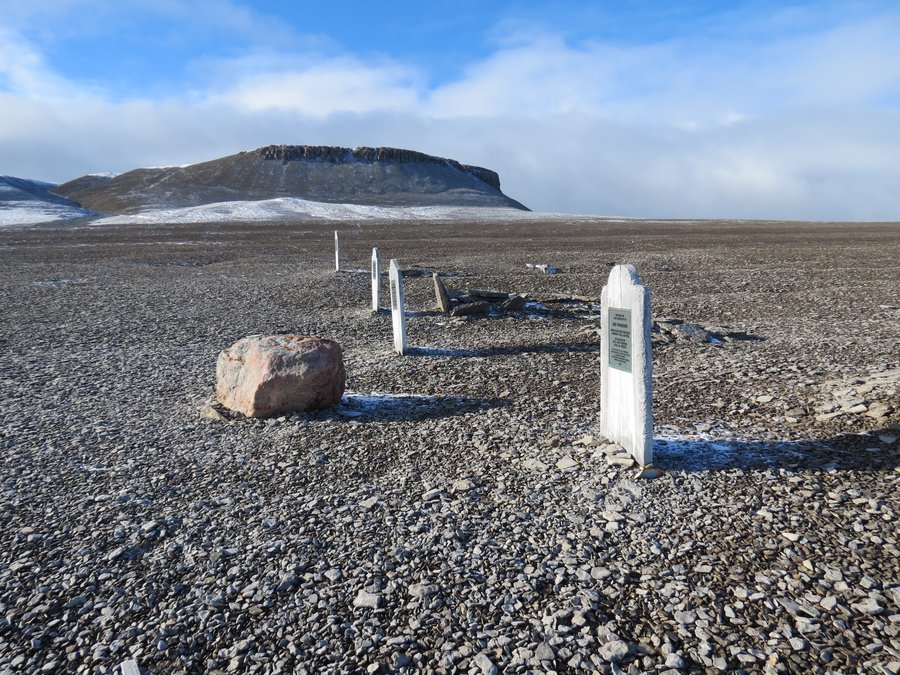
McGoogan has visited the Arctic 12 to 15 times throughout his career. Those journeys have not only enriched his writing but profoundly shaped his understanding of the region. Upon visiting Beechey Island in 2007, he was struck by the absence of ice, a sharp contrast to Kane’s 1850 descriptions of a formidable frozen landscape.
“The difference in climate is extraordinary,” he notes. Yet despite these dramatic changes, he continues to be inspired by the resilience of the Inuit and other Indigenous peoples, whose adaptive genius has allowed them to thrive in a shifting environment for generations.
With seventeen books to his name, six of them focused on the Arctic, Ken McGoogan has carved out a singular place in Canadian literature and historical scholarship. Through decades of dedicated research, fieldwork, and storytelling, he has helped the world see the North not as an empty frontier, but as a rich tapestry of people, cultures, and stories waiting to be understood.
His work ensures that figures like John Rae and Lady Franklin are no longer consigned to the margins, but are given their rightful place in the story of human endurance and discovery.
As for what lies ahead, McGoogan is already immersed in a new project. Titled “Canadian Defiance”, the book will explore Canada’s resistance to American incursions that began during the American Revolution, blending political history with his signature narrative flair.
For more information, visit Ken’s website
