Parks Canada should revive Battlefield site
Today in the Globe and Mail, Page O8.
Ken McGoogan is writing a book whose working title is The Yanks Are Coming: A Neverending Story of Invasions, Shakedowns, and Canadian Resistance.
In late October, Parks Canada announced 11 “new designations of national historic significance” across the country.
These included persons, places and events, among them Métis explorer William Kennedy and Mohawk women’s activist Mary Two-Axe Earley. Seven Oaks House in Winnipeg, the site of two of the oldest buildings in the city, was commemorated, as was rural electrification across Canada and the Miramichi Fire of 1825. I have no argument with recognizing any of these.
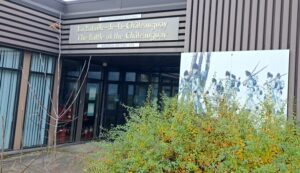
But i do have a question. No, make that a querulous complaint. In times like these, when the existence of Canada is under threat from U.S. president Donald Trump, why has Parks Canada closed a fully built interpretive centre at a historical site that speaks directly to our current predicament?
I refer to the centre at the Battle of Châteauguay National Historic Site, located little more than one hour by car southwest of downtown Montreal. While an obelisk and a riverside picnic area remain accessible, they do not even hint at the historical significance of this locale, which to my mind is one of the most meaningful in Canada.
 Here it was that, on Oct. 26, 1813, a small contingent of Canadian, British, and First Nations fighters repelled an assault by a far larger army of American invaders bent on seizing and occupying Montreal as the coup de grâce in the War of 1812.
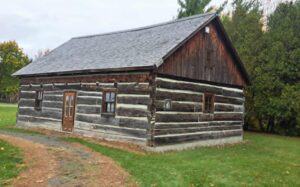
A few days ago, 212 years to the day since that historic Canadian victory, I visited the site overlooking the Châteauguay River. I took photos of the river, the commemorative obelisk, and an intriguing log building (while wondering what it once was). The entrance to the interpretive centre was locked up tight.
Most historians agree that the combined Canadian and British forces – regulars, volunteers, militia, and First Nations warriors – totalled around 1,500 or 1,600 men, although only some 460 actively engaged in the fighting, (mostly French Canadians with a contingent of Mohawks.)
By the time of this battle, the American plan was set. With Upper Canada still contested and the niagara frontier unstable, the invaders turned their attention to Montreal. If they could capture that city, they could sever the St. Lawrence River lifeline, split the British colonies of Upper and Lower Canada, and bring an end to British control in Canada.
The American offensive would proceed from two directions, one column advancing eastward from Niagara and Lake Ontario, the other moving north from near Lake Champlain, toward Montreal.
This advance from the south was led by Major-General Wade Hampton, a veteran of the American Revolution and a political appointee from South Carolina. He started north with more than 4,000 troops, although 1,400 New York militiamen refused to cross the Canadian border, leaving him with 2,600 soldiers. His goal was first to defeat whatever small force might oppose him, and then to link up with the American column coming from Niagara to mount a joint attack on Montreal.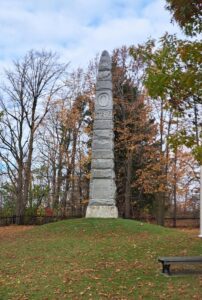
The resistance was led by Lieutenant-Colonel Charles de Salaberry, a French-Canadian seigneur and career officer in the British Army. Born near Quebec City at Beauport in 1778, de Salaberry had served with distinction in the British Caribbean and understood both the discipline of regular troops and the improvisational skill of irregular warfare. He commanded a unit of French-Canadian light infantry known as the voltigeurs, trained to fight in forests and rough terrain.
The Battle of Chateauguay unfolded in thick forest and along narrow trails. American scouts struggled to locate the defenders. Musket fire erupted from concealed positions. Bugle calls echoed across the trees – some real, some staged by de Salaberry’s men to suggest larger numbers. The effect was disorienting. The Americans, unable to find a clear line of attack, stumbled into ambushes and crossfire.
By nightfall, the Americans had suffered only modest casualties – roughly 23 dead, 33 wounded, and 16 taken prisoner. Yet, clearly defeated, they abandoned their offensive and retreated.
Soon afterwards, on Nov. 11, 1813, at Crysler’s Farm near Morrisburg, Ont., some 800 British, Canadian, and First Nations forces drove back the 4,000 Americans proceeding eastward from Niagara to join forces with Hampton’s men. The two-prong American assault had come to naught.
Obviously, if the Americans had succeeded in taking and occupying Montreal, then Canada itself would have evolved very differently, and might, indeed, have become little more than a footnote in American history.
 The battle of Chateauguay was a crucial turning point in the Canadian story of resistance. The Parks Canada interpretive centre commemorating that battle should be resurrected, restored, and refurbished.

Well said Mr. McGoogan
Continue this fight
People (Canadians in particular) need to be aware of these facts
Good Luck ~ stay the course